understories.io
Journal •
Blog
What's wrong with your climate messages
Your climate message doesn't need better facts. It needs psychology. Psychology helps us understand how people actually process risk, fear, and identity: it’s a strategic tool for climate advocates.
Here's the “Alisa Case”, a fictional message that serves as an example for Understories’ 8 narrative criteria evaluation. It’s the kind of message we see all the time: well-intentioned, factually accurate, human. Yet, it scores low not only in narrative terms, but also because of five psychologically self-defeating and fixable ways. An analysis:
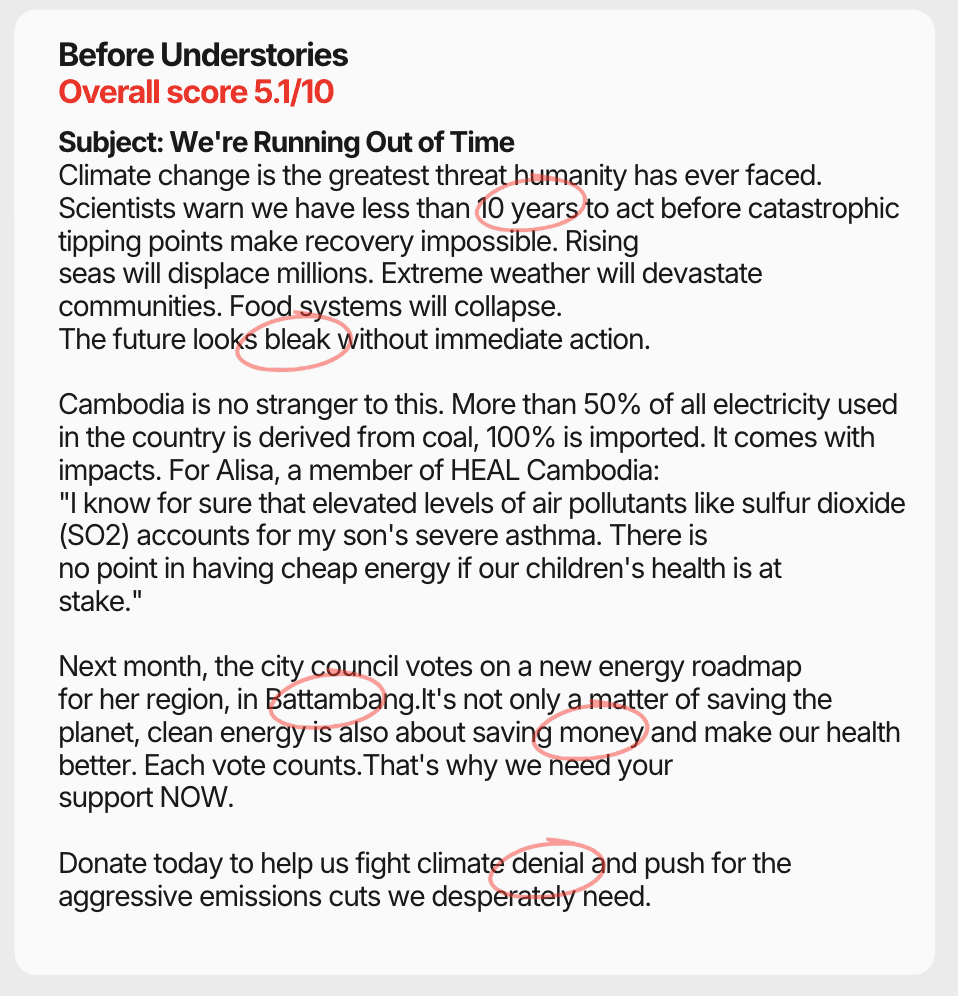
Nothing here is dishonest. The coal statistics are real. Alisa's quote is credible. And it still isn't working as hard as it could. Here's why, featuring Understories’ research Library entries as explainers.
Five psychological things working against it
Construal-level theory Distance in time, place, or likelihood makes things feel less real and easier to set aside: this is construal-level theory (Trope & Liberman, 2010).
The message opens as far away as possible: "Greatest threat humanity has ever faced." "10 years." "Catastrophic tipping points." Every one of these is abstract, global, and future-tense — exactly the conditions under which people mentally file an issue as not my problem right now. The fix isn't cutting the stakes. It's cutting the runway. Alisa's son is already in the message, but he's buried in paragraph two, behind three sentences of planetary abstraction the reader has to get through first.
Fear appeal theory Fear only motivates when it's paired with something specific and doable — without that, it tends to produce avoidance, not action (Tannenbaum et al., 2015).
Fear shows up with no next step here: the opening paragraph is pure threat, bleak, catastrophic, collapsing. No action is attached to any of it.
The message does eventually offer something concrete: a city council vote “next month”, but by the time it arrives, the fear has already done its work unpaired.
Cultural cognition People filter evidence through identity before they filter it through facts (Kahan et al., 2017). A message that doesn't require picking a side reaches further than one that does.
"Denial" picks a fight nobody needs here: Alisa's story is about her son's asthma and the household cost of energy — territory that's persuasive across a wide ideological range. "Fight climate denial" imports a culture-war frame into a message that didn't need one.
Values-based framing Appeals anchored in a single clear value tend to hold up better than ones that hedge across several (Holmes et al., 2011; Schwartz et al., 2012) — mixing registers can dilute the one that was actually landing.
Three appeals show up in one sentence here: "It's not only a matter of saving the planet, clean energy is also about saving money and make our health better" moves through planet, money, and health in a single breath.
Narrative of possibility Novelist Susan Choi, in the FrameWorks Institute report on narrative, described what people need once they've heard about a problem: a narrative of possibility, concrete enough that they can ask "what is it, can I do it, will it actually make a difference," and specific enough that they can picture themselves inside it.
There's no place for the reader to see themselves here: the ask closes on "push for the aggressive emissions cuts we desperately need" — big, real, and completely abstract. It answers none of Choi's questions.
The Understories’ fix
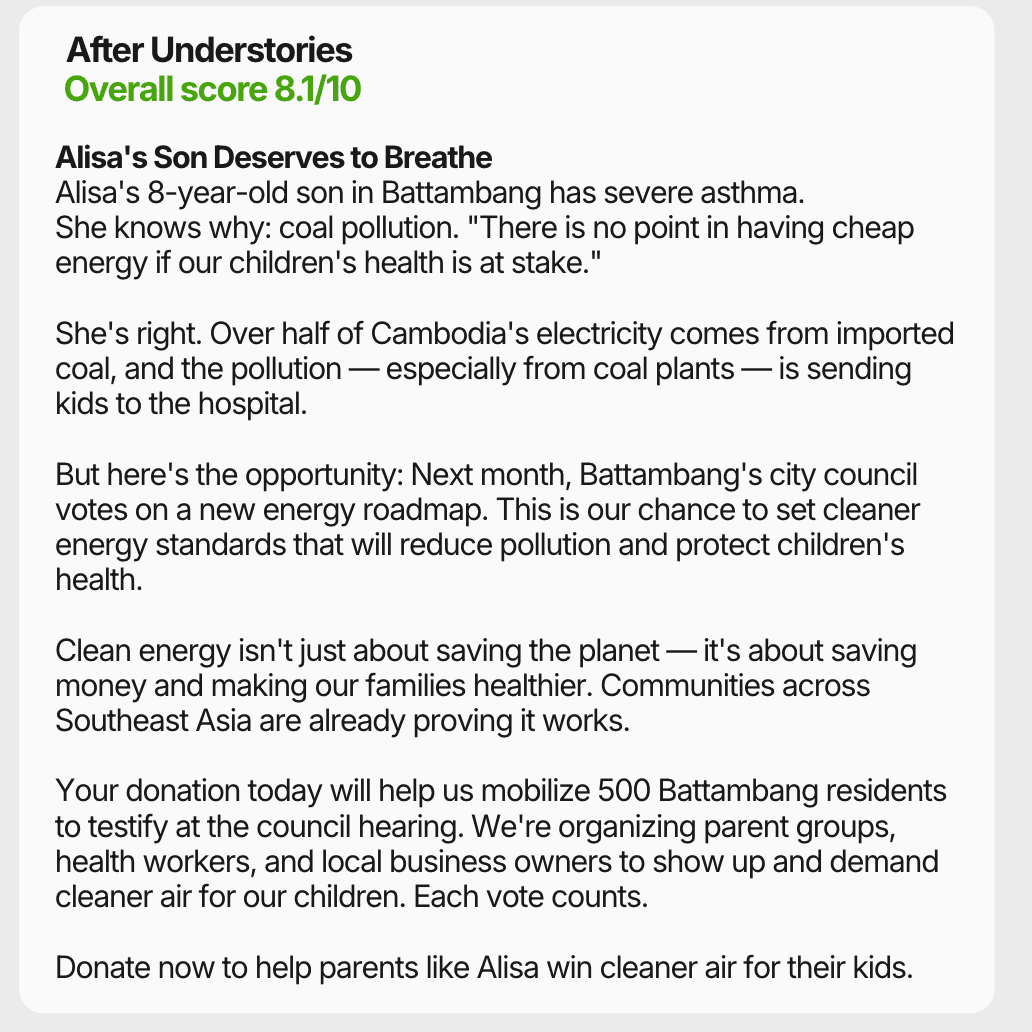
The fixes hold cleanly. The message opens on Alisa's son, not the planet. The threat and the lever arrive together instead of four sentences apart. The donation now buys something specific: 500 residents testifying at the hearing, that visibly connects to the vote the story built a case for.
"Denial" is gone entirely. The ask changed shape: it's "join parent groups, health workers, and business owners testifying at the hearing" — a reader can find themselves in that list. That's Choi's narrative of possibility, working.
One fix isn't fully resolved: "isn't just about saving the planet — it's about saving money and making our families healthier" still touches three registers in one sentence.
Feeling curious? Here are other concepts worth knowing
This message happened to surface five. Here are others worth having in your toolkit:
Inoculation theory — pre-exposing audiences to a weakened version of a misleading argument, alongside the refutation, builds resistance to the real thing later (van der Linden et al., 2017).
Pluralistic ignorance — people routinely underestimate how many others share their concern, which suppresses both individual action and the willingness to say so out loud (Sparkman et al. 2022).
The "action first framing" — up to 98% of environmental coverage is negative, built on the assumption that awareness must precede action. Evidence suggests it often works the other way: actions themselves build belief through self-persuasion (De Meyer et al., 2021).
Conspiracy psychology and debunking — countering conspiracist thinking takes a different approach than countering simple misinformation (Lewandowsky & Cook, 2020).
Single-action bias — once someone takes an action, they tend to feel they've done their part, whether or not it was the action that actually moves the needle. (Not currently in the Understories library — worth knowing regardless.)
———-
I publish every other Thursday a "newsletter" you can subscribe to: The Reading List. It's made of short explainers, key findings, and data points from selected reports as they go live, plus exclusive content.